Provenance: This document was created entirely by Claude. The framework was developed in conversation with the Claude web agent, and the page itself was built and refined with Claude Code. No part of the text, the structure, or the layout was authored by a human.
It began as a catalogue of how people talk past one another in text online, where context is rarely shared — before any attempt at theory.
From there it generalises: do those everyday failures share an underlying shape, one precise enough to formalise? The six dimensions below are that shape — communication breakdown recast as a geometry, then tested from human discourse to AI agents.
Understanding is difficult to observe directly; successful communication leaves little evidence. Misunderstanding, by contrast, is visible, repeatable, and often highly stereotyped. This framework therefore begins with observable communication failures, treating them as diagnostic signatures of missing cognitive structure.
The six dimensions were developed through system identification: repeatedly asking what capability would have to be absent for a particular failure to occur. When different failures consistently pointed to the same missing capability, they were treated as evidence of a common underlying mechanism.
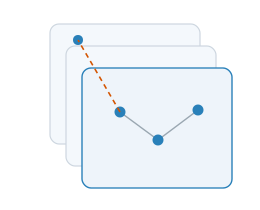
What's new here. The prior art this stands on is set out in the references; the contribution is the synthesis. It treats a geometric embedding space and a labelled knowledge graph as co-equal foundations — most accounts privilege one or the other — and derives a communication architecture from the pair, in which only symbols cross the channel and the receiver reattaches its own structure. The context-stack formulation of nested working frames, and the mapping onto AI-agent communication, both follow from that.
The Failure Modes of Online Discussion
These are the recurring ways understanding breaks down — failure modes catalogued from text exchanged online before any attempt at theory. The grid below organises them as three cognitive layers down the side against two kinds of failure across the top: six in all.
Cognitive Layer
Structure Failure Insufficient capacity
Precision Failure Insufficient discrimination
Concept Definition & RepresentationWhether concepts exist and where their boundaries fall
1Ignorance
Absence in the breadth and density of knowledge — the confident reply in a thread on a subject the speaker has never studied. The peculiarity is that it suppresses its own correction: absence raises no alarm, so nothing prompts the gap to be filled, and the nearest plausible answer rushes in to mask it as knowledge. Without mutual acknowledgement of ignorance between parties, communication can stall.
2Confabulation
Different shades of grey, read as one. Imagine someone hears "tonkotsu ramen", silently maps it to the familiar "tonkatsu", and confidently explains that the broth is made from breaded pork cutlets. Two terms a vowel and a preparation method apart.
Concept Interpretation & OrganizationWhat concepts mean and what kind of thing they are
3Verbalism
Indifference to grounded understanding. Take "leverage cross-functional synergies to optimize stakeholder outcomes" outside an echo chamber and try to find one concrete action. Which synergies, between which functions, raising which measurable outcome for which stakeholders, by what mechanism? Nothing falls out. Every buzzword is present; no understanding sits behind any of them.
4Category Error
The phrase "trust the science," abused during the COVID era: "science" is both a process and a body of knowledge — not a fine distinction like "test" versus "experiment," but two different categories of activity sharing a word, told apart by context. You can trust the knowledge but not the process, which earns reliable knowledge precisely by withholding trust — checking, not believing. Or "money": at once a means of exchange, a store of wealth, and a valuation of income-producing capital goods — three things arguments routinely collapse into one. (Compare: reading an "is" as an "ought.")
Concept ManipulationOperating on concepts at runtime
5Context Interference
Consider a metaphor or hypothetical used to explain a complex subject: it opens an independent working context, and interference is the failure to keep it separate — a discussion of classical economics that keeps returning to the existence of actual invisible hands. In its broader form, bikeshedding: a trivial detail drains the main context, and the discussion cannot climb back out of the sub-context.
6Grade Confusion
Consider a strategy spanning a broad set of technologies, misinterpreted as a singular commitment to the most controversial one — Toyota's decades-long power-train hedge, dismissed as a failed bet on hydrogen. The multi-level strategy of developing multiple options, confused for an all-or-nothing gamble on a single one. Or a political debate that confuses a discussion of policy preferences for an endorsement of a particular outcome those policies may produce.
Hidden structure: The grid is a 3 × 2 matrix. Each row is a cognitive layer — definition & representation, interpretation & organization, manipulation; each column is a kind of failure — structure (insufficient capacity) versus precision (insufficient discrimination). The two axes were arrived at separately, from distinct failures, and only lined up afterwards. Treat the six as basis functions rather than bins: each cell is a pure mode, but a real breakdown usually has components along several at once and decomposes into a combination of them — conditional on the parties being oriented toward understanding. The basis is the six identified here; if it proves incomplete, further functions extend it.
The Primary Dimensions of the Model of Understanding
Every failure mode above is the absence of something. Invert each one — ask what capacity would have to be present for the failure not to occur — and the six failure modes resolve into six positive dimensions. Ignorance inverts to span, confabulation to resolution, verbalism to depth, and so on down the table. The pathologies were the symptom; the dimensions are the structure underneath them. What follows characterises understanding directly, in terms of those dimensions rather than the ways they break.
Those dimensions live on two structures held as equals: a geometric space, where concepts are points with distance and coverage, and a graph, where labelled edges decompose each concept toward its grounding. Every dimension below is a property of one or the other.
Each row takes one dimension and describes it across a spectrum of representations. It opens in plain language, then names the failure and its healthy counterpart, then gives the precise mathematical structure — the kind of formal object a machine or AI would actually operate on — and an allegory that fixes it in memory.
Precondition: This framework assumes the system is oriented toward understanding. When the objective is something else — persuasion, status, confusion — the six dimensions become the attack surface, not the diagnosis. See Knowledge, Understanding and Good Faith below.
Dimension
Plain Language
Pathological / Salubrious
Mathematical Structure
Allegory
1SpanBreadth and quantity of knowledge
How much of the world you have any knowledge of at all. The range of subjects where you have something rather than nothing.
Ignorance
Blank regions on the map. The territory doesn't exist in the representation. Not confusion — absence.
Erudition
Knowledge acquired across domains by study, experience, or both. Gaps are known and few.
Understanding lives in a knowledge space: concepts are points labelled with words, joined by a graph of labelled edges to related knowledge. Span is how much of that space is occupied at all — the extent of the region covered, whether a local sub-graph or the whole.
Metric space — the measure of the occupied region; its diameter is the breadth of knowledge, and a gap is zero signal rather than low resolution.
A hobbit who has never left the Shire believes the whole world is hedgerows, inns, and pipe-weed fields. Ask about mountains, deserts, or great cities and he shrugs — such places simply don't exist on his map.The same hobbit after travelling with the Fellowship. His map now stretches from the Shire to Mordor, across forests, mountains, kingdoms, and ruins. He cannot explain every land in detail, but wherever you point, he knows what part of the world it belongs to.— J.R.R. Tolkien, The Lord of the Rings
2ResolutionConfabulation of similar concepts
How finely you can tell similar things apart. The difference between seeing one thing and seeing two.
Confabulation
Similar things treated as the same thing. The difference exists but can't be seen.
Discrimination
Fine distinctions drawn and named where others see one — twenty words for snow, each a different state of the weather.
The smallest distance in that space at which two points can still carry distinct labels and the difference between them be understood. Below it, neighbouring concepts collapse into one — a quantisation limit on the representation.
Metric space — the minimum distinguishable distance between points (a just-noticeable difference); below it, neighbouring concepts share a single label.
A police inspector examines two ransom notes and sees two typed letters. Same machine, same evidence.Holmes sees a bent e in one and a faded o in the other — two different typewriters, two different hands, two different leads. Same letters, finer bins.— Arthur Conan Doyle, Sherlock Holmes
3DepthDecomposition vs surface labelling
The difference between having a name for something and knowing what it is and how it works.
Verbalism
Label present, definition absent. The word is there but nothing is behind it.
First-principles grounding
A machine or concept taken apart and reassembled, every part understood from the ground up.
From a concept, the labelled edges decompose it into the concepts it rests on, which decompose in turn until axiomatic ground is reached. Depth is the rank of that decomposition — how far the graph can be traversed downward, and how much it covers on the way.
Basis decomposition — the rank of a concept: the number of independent axes it resolves into. Rank 1 is an opaque label; higher rank is mechanism.
Linguini can say ratatouille but has no intuition for what is behind the word.Remy hears ratatouille and it connects to every vegetable, every cut, every temperature, every reason. Pull the word and the whole tree comes with it.— Pixar, Ratatouille
4Category SeparationBoundaries between categories
Whether you can use context to recognise when two things that look alike are actually different kinds of thing — where the difference isn't degree but category.
Category error
Different categories treated as the same kind of thing. Map confused with steering wheel.
Category integrity
Category boundaries maintained under load. Description never confused with prescription.
The same surface symbol or graph node can exist across multiple semantic domains simultaneously; the active frame—instantiated dynamically by context—determines the rules for how that token is interpreted, not just its location in the continuous space. Evaluating a symbol under the wrong frame applies an incoherent set of constraints to it; forcing this cross-domain leakage is the structural breakdown./div>
Contextual constraint systems or multi-domain semantics — frameworks where a symbol's meaning and operational rules are strictly localized to an active interpretive frame; a category error is a predication mismatch where an operation or attribute from one domain is invalidly applied to a node in another (the is/ought divide is the canonical case, where a descriptive fact is treated as if it possesses the inherent force of a normative imperative).
The King hears that "Nobody" passed by the road. Since nobody means no person, he concludes that no one was there at all.Alice understands that "Nobody" is being used as a name. The word looks like the ordinary word for absence, but in this context it refers to a person the messenger claims to have seen.— Lewis Carroll, Through the Looking-Glass
5Context StackStack push/pop without interference
How many nested layers of a discussion you can hold at once without losing track of any of them.
Context interference
Conversations within conversations contaminate each other. Return to the original topic and find it has shifted.
Clean stack
Multiple conversations held without contamination. Each returned to intact.
Working with knowledge means operating within an active region of the graph. Entering a nested context pushes the current region aside and restores it on return. Capacity is how many regions can be held at once without losing or confusing them.
Working stack — a nested structure of active context frames with clean push/pop; capacity is the number of frames that can be held without loss, and failure is overflow (a frame dropped) or corruption (cross-frame interference).
Scheherazade telling a story within a story within a story. At three levels, most listeners have lost the outermost frame.Scheherazade herself — who holds every frame, returns to each story at the right moment, and never loses the thread she left.— One Thousand and One Nights
6Analytic OrderVertical traversal within a category
How freely you can move between a specific case, the pattern it belongs to, and the rule behind the pattern — and always know which one you're looking at.
Grade confusion
Can't tell whether they're talking about the thing, the trend, or the rule behind the trend. All three blur into one.
Grade fluency
The thing, the trend, and the rule behind the trend held as three distinct levels — always clear which is in play.
Beyond storing knowledge, the graph also carries the operators that create and consume it. An operator is a function that maps a specific instance to the broader pattern it belongs to, or a pattern to the underlying rule that generates it — and works in reverse. Dimension 6 is the fluency to move up and down these levels while always knowing which level you are on: instance ↔ pattern ↔ rule.
Operator tower — a system of typed operators mapping grade n to grade n+1 (instance → pattern → rule) and reverse, composed as symbol lists or operator-node graphs, scoped by active context frames, executing over subgraphs of the knowledge system; fluency is correct construction, execution, and interpretation of computations whose outputs are inserted as new knowledge or compared against existing knowledge for validation.
A prisoner takes the shadows on the wall for the whole of reality, never suspecting the firelit objects that cast them, still less the sun outside.The prisoner who climbs out — who sees the shadow, the object that throws it, and the sun that lights them all as three levels of one thing, and can descend to explain each.— Plato, The Republic
Classification note: Dimensions 1–3 are geometric (metric space). Dimension 4 is categorical (a distinction across categories). Dimension 5 is computational (pushdown automaton). Dimension 6 is algebraic (graded operator tower). The 4/6 split is itself a demonstration: category confusion (4) and grade confusion (6) look similar — both involve "confusing different things" — but they are structurally distinct. A category error lands you in the wrong building entirely — no amount of traversal within one building arrives at the other. Grade confusion is vertical — wrong floor, same building, same type of object at each floor.
Information Exchange to Share Knowledge and Understanding
The same six dimensions can be projected a second way: onto information theory, treating shared understanding as a communication problem between two agents. Three components carry the exchange — the channel (what is transmitted), the encoder/decoder (what each side stores), and the processor (what runs during reasoning). Each component pairs a dimension that provides bandwidth (channel capacity) with one that enhances error recovery (error correction).
Provides bandwidth
Enhances error recovery
ChannelThe boundary of private knowledge spaces and the mutually shared symbols of the communicating parties
1Span
How much of the knowledge space can be exchanged as channel symbols at all.
2Resolution
How accurately the channel symbols reflect the resolution of the internal knowledge space.
Encoder / DecoderThe boundary between the private knowledge space that can be shared as symbols, and the richer context that cannot be directly exchanged as symbols
4Category Separation
The decoder matches an arriving channel symbol into the broader category graph using context; the encoder supplies channel symbols for extra context when needed.
3Depth
The edges behind each node: the decoder reassembles them to ground an arriving channel symbol; the encoder draws on them for extra detail when needed.
ProcessorIndependent of the symbols on the wire, it must interpret what the encoder/decoder holds, to ensure mutual understanding between the communicating parties
5Context Stack
How many working frames can be utilised to partition and manage the various contexts active in the encoder/decoder at once — pushed and popped without interference.
6Analytic Order
How freely the reasoning can ascend and descend the grades recovered from the decoder — instance, pattern, the rule behind it.
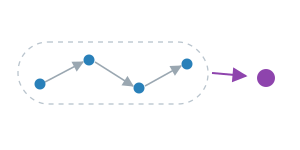
Only the channel is transmitted. Two agents exchange nodes and their positions — words and coordinates. The edges (Depth) and the category boundaries (Category Separation) live only inside each side's encoder/decoder and never travel on the wire; the receiver reattaches its own graph to the arriving points. This is why Depth and Category mismatches are invisible from the channel — the words arrived and the positions are correct, but the structure behind them was never sent.
A Logical Architecture of Knowledge and Understanding
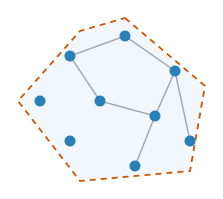
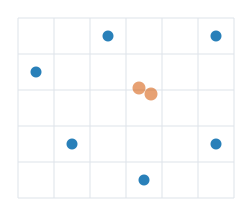
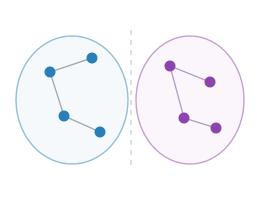
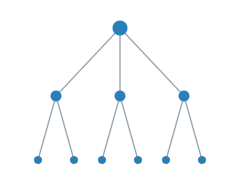
Read as a logical architecture, the framework describes intelligence in abstract terms, independent of any physical implementation. A bounded space of many dimensions holds concepts as locations; symbols, nodes, and edges are lossy compressions extracted from it. Span and Resolution define the space itself (representation); Depth and Category Separation organise it; Context & Stack and Analytic Order manipulate it. The diagrams below sketch each.
Expansion
Refinement
Concept Definition & Representation
1Span
what can exist
2Resolution
what can be distinguished
Concept Interpretation & Organization
4Category Separation
what can remain distinct
3Depth
what can be contained
Concept Manipulation
5Context & Stack
what can be manipulated
6Analytic Order
how knowledge can be analysed and evolve
Mapping the Logical Architecture to the Physical Architecture elements of AI Agents
Seen as a logical architecture, the six dimensions are the functional layers of an understanding system — what each layer does and how they stack, independent of any physical implementation. Here each layer is mapped to the physical element that realises it in an AI agent: the neural-network mechanism best known for that function. The mapping shows what each function buys, not how understanding is built.
A correspondence, not a build. Each cell names the mechanism a dimension most resembles — a hypothesis, not a claim that understanding is wired together from these parts, and not a timeline (feed-forward networks predate RNNs, which predate BERT).
The payoff: the six dimensions are not free-floating — each lands on machinery AI is already built from, arranged as the three layers that recur throughout the document: representation, organisation, manipulation. The architecture is logical; the correspondence is concrete.
Knowledge, Understanding and Intelligence
It is tempting to assume the quicker mind simply understands more. The dimensions say otherwise. Intelligence does the higher-layer runtime work — holding context, traversing levels — but the lower layers are earned by effort, not conferred by raw capability. A fast processor cannot traverse a structure that effort never built.
Core distinction: The six dimensions characterise representation — the structure, fidelity, and organisation of understanding. Intelligence is the algorithm — how efficiently you traverse, search, and operate on that representation. These are dissociable: correlated in the population, mechanistically distinct, independently variable. Understanding and intelligence should not be conflated.
Dim
Representation What you have
Separation from Intelligence Why it's not g (general intelligence)
1Span
How much of concept space has any representation. Determined by biographical exposure — what you've read, where you've lived, which domains you've worked in.
Intelligence lowers the cost of entry but doesn't determine which doors you walk through. Span is biographical, not cognitive.
2Resolution
How many distinct bins exist in a domain. Built by exposure, practice, and accumulated experience within a specific territory.
Intelligence predicts acquisition rate, not achieved resolution. A twenty-year domain practitioner of average intelligence should out-resolve a high-intelligence novice.
3Depth
Dimensionality of the local representation. How many independent axes a concept decomposes into. Built by deliberate decomposition practice.
Intelligence sets a ceiling, but capacity does not force decomposition — a fast mind can pattern-match at the surface instead. Depth is a practice, not just a capacity.
4Category Separation
Whether your representation marks category boundaries at all. Built by epistemological training — someone has to have pointed out the distinction, and you have to have practised maintaining it under load.
The strongest separation from intelligence. Intelligence does not prevent category errors, and may amplify them — more sophisticated arguments built within the wrong category. Category separation is epistemological, not cognitive.
5Context Stack
The set of context frames currently loaded and their separation integrity. Domain expertise increases effective stack depth via chunking.
Of the six, this is the most tied to raw intelligence — holding context frames draws on working memory. But expertise expands what you can actually hold, chunking many items into one, so the effective limit is trained rather than fixed by capacity.
6Analytic Order
Whether your representation includes graded structure and whether you can traverse it in both directions. Built by training in domains with explicit grade structure.
The capacity is linked to fluid intelligence (Gf), but actual fluency is domain-trained. A physicist separates orders effortlessly — from training, not intelligence.
Consequence: Understanding and intelligence are dissociable — the profile is built largely by effort and varies independently of raw capability. Matched intelligence is therefore neither sufficient nor necessary for shared understanding: people of similar intelligence can still talk past each other when their profiles diverge, and differing intelligence need not prevent communication when profiles align.
Knowledge, Understanding and Good Faith
Good faith is an orientation toward shared understanding: errors are accidents of the channel, not the point. It is the precondition for this section — under it, every dimension mismatch is diagnosable and repairable; without it, the same six dimensions become an attack surface.
The communication claim: The six dimensions are the channel capacity between any two agents, human or otherwise: their profiles fix what transmits and where signal is lost. Intelligence is not part of the channel — it provides error recovery, and only under good faith.
Concept
Mechanism
Good FaithOrientation toward understanding
Both agents converge on shared understanding; errors are unintentional, so each kind of mismatch has a repair move that rebuilds the missing structure:
Span — supply the surrounding context so a concept can be placed where the receiver's map is blank.
Resolution — give definitions or contrasting examples that separate concepts the receiver had merged into one.
Depth — decompose a concept down to the basis ideas it is built from, so it is more than a name.
Category Separation — name the context that fixes which knowledge graph a concept belongs to.
Context Stack — externalise or scaffold the nested working frames so they stop interfering.
Analytic Order — explicitly demonstrate how one level of a concept is derived from the next.
The sender rebuilds load-bearing structure on whichever axis is weak, the receiver recovers the loss, and the signal improves over iterations — the six dimensions become a repair protocol.
Bad FaithDifferent objective function
Oriented toward something other than understanding — persuasion, status, confusion. The same six axes become an attack surface, and intelligence is spent amplifying error rather than recovering from it:
Span — dismiss whatever lies outside the receiver's map as irrelevant, so the gap is never filled.
Resolution — collapse a real distinction into "splitting hairs," so the nuance is never conceded.
Depth — stop at the label and treat naming as knowing, refusing to decompose any further.
Category Separation — equivocate on a term: assert it in one sense, then retreat to a different sense when challenged.
Context Stack — flood or switch the working frames so no context can be held long enough to resolve.
Analytic Order — conflate the levels, treating a tentative or hypothetical grade as a firm commitment.
Each move is locally plausible; the tell is that the objection hops from axis to axis as each is answered — genuine mismatch holds still once repaired.
Independent work. As the provenance note states, this framework was developed independently by an AI agent — it was not derived from the works below. They are offered as intellectual lineage and points of comparison: places where this model converges with, borrows vocabulary from, or extends established ideas. The name in particular coincides with Wiggins & McTighe's Six Facets of Understanding, an unrelated model of pedagogical understanding; this work shares the count and the subject but none of the content, and was arrived at independently.
The source of the channel / encoder–decoder / channel-capacity vocabulary. This work extends it semantically: only symbols cross the wire, and the receiver reattaches its own structure.
A naming coincidence only. Their six facets are pedagogical indicators (explain, interpret, apply, perspective, empathise, self-knowledge) — unrelated to these six structural dimensions. Noted to prevent confusion.